
In a healthy spine, the disc is appropriately thick and supple. However, discs can begin to show signs of wear due to age, disease or injury. and show signs of degenerative disc disease. When this occurs, the surrounding nerves can be compressed, leading to discomfort. While less intrusive treatments are usually considered first, such as medication, steroids, or physical therapy, surgery in the form of full disc replacement may be necessary for advanced cases that do not respond to treatment. The goal of disc surgery is to relieve nerve root pressure and allow normal movement for the neck or lumbar areas.
Total Disc Replacement 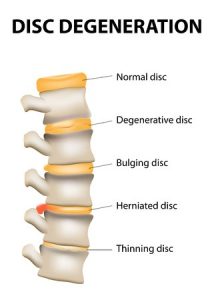
In spine disc replacement procedures, problematic discs are removed through tiny incisions to gain access to the damaged discs are replaced with an artificial alternative. This allows the spinal joint to be rebuilt, providing the necessary cushion for normal function. However, there are several different procedure options, each with its own nuances. You should learn about each procedure after a consultation and screening from your physician in order to assess which option is right for you.
Disc Replacement for the Lumbar Spine
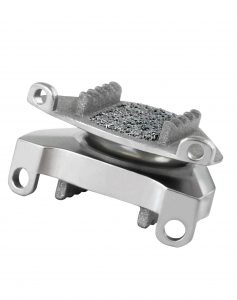
In lumbar disc replacement procedures, problematic discs are removed to address problems in the lower back from segmental instability and nerve irritation which may present itself as pain, spasms, or muscle tension. Damaged discs are replaced with a metal implant with a plastic middle. This essentially forms a ball and socket joint. Because of this, the procedure allows for have excellent mobility and an advanced range of motion unavailable in lumbar spinal fusion procedures.
 Cervical Spine Disc Replacement
In this procedure, you are usually targeting two adjacent cervical vertebrae. This also features a metal component, which is attached to the vertebrae in order to keep the spinal components from touching. This can greatly reduce the amount of pressure on the surrounding nerves, which often provides immediate relief for pains in the arm or neck that are usually associated with cervical disc problems. Patients can expect much better mobility compared to cervical fusion procedures. The hardware has been designed to mimic the full movement of the spine, allowing for extension, side bending, full rotation and more.
If you are suffering from back, neck, or shoulder pain or are in need of spine surgery, the Spine Institute Northwest offers minimally invasive procedures to help you get your life back. Call us at 206-496-0630 or fill out our diagnostic pain diagram form here.